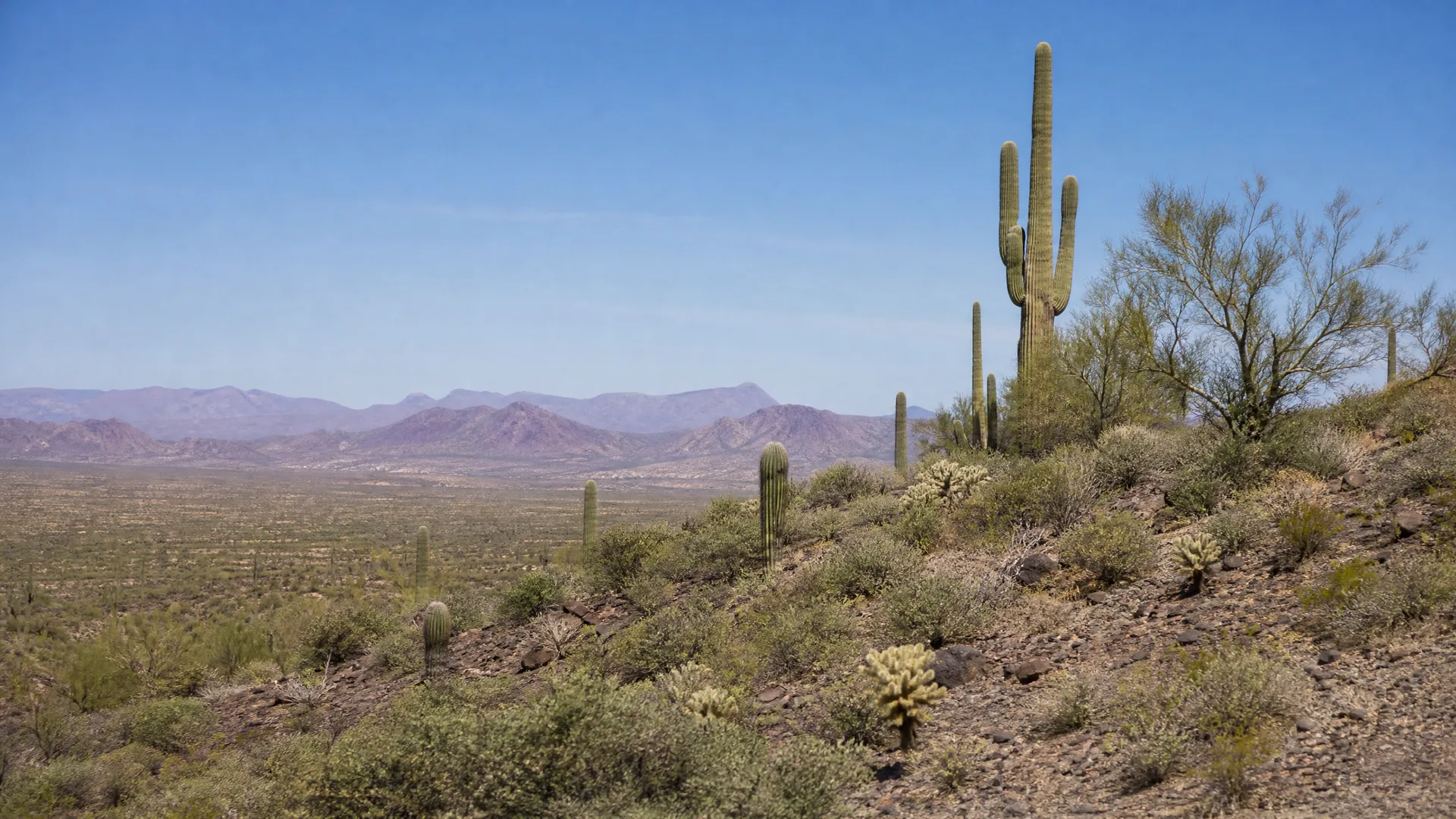












Desert hillside with saguaro and cholla cacti, low shrubs and rocky ground, overlooking a broad valley with distant hazy mountain ranges under a clear blue sky.Let a pro reach out

Does a heat pump handle humidity in Arizona

Send the form and the search for an installer is over.

A heat pump in Arizona has an easier job than people expect. Summers here are hot and dry, not muggy, so the system isn't fighting to pull moisture out of the air the way it would somewhere humid. Most of its work is just moving heat out of your house in July and moving it back in come January.

Dry air doesn't mean the humidity question goes away entirely. A heat pump still has a coil and a blower that handle whatever moisture is in the air, and how well that happens has more to do with the system being sized and installed right for your house than with Arizona's climate working against it. An oversized unit cools the air fast and shuts off before it's done much of anything to the air quality in the room. The wrong setup can leave rooms feeling clammy even when the readout says it's cold enough.

That's the part worth getting right at installation, not after. Power here runs at a typical price and most homes already heat with electricity, so a heat pump fits the way this area is built and run. Getting the sizing and setup matched to your house is what decides whether you feel that benefit or just paid for it.

You don't have to track down who in your area actually installs these correctly, sit through three different phone quotes, or explain your house's layout over and over to people who may not even show up. Send the form once and that search is off your plate. Someone qualified to size and install a heat pump for your home takes it from there.

Will a heat pump handle humidity okay in Arizona?

You've heard horror stories about heat pumps struggling in humid climates, where the system has to work overtime pulling moisture out of the air on top of cooling it. You want to know if that applies here before you install one, or if Arizona's dry air changes the picture entirely.

Yes, because there's almost no humidity for it to handle

A heat pump removes moisture as a side effect of cooling, not as its main job. In Arizona, the air is already dry most of the year, so there's little moisture for it to pull out in the first place. That's the opposite of what happens in a humid state, where the system has to run longer just to wring water out of the air before the house feels cool. Here, a properly sized heat pump cools the air quickly and shuts off, since it isn't fighting moisture at the same time. The dry air also means the home won't feel sticky even when the system isn't running constantly. Sizing still matters, but humidity isn't the thing to worry about.

A gray outdoor air conditioning condenser unit on a concrete pad beside a house with horizontal siding, next to a green lawn and a plain light-colored wall.

What low humidity changes for the system

A heat pump pulls moisture out of the air as a side effect of cooling, not as its main job. In a humid state, the coil stays wet most of the time and the system runs longer to wring that water out along with the heat. In Arizona, the coil has little moisture to deal with, so almost all its runtime goes toward dropping the temperature. That's a simpler job, cycle after cycle.

A white outdoor heat pump unit on a concrete pad beside a plain light wall, with gravel and mowed grass in front.

What matters more here than moisture

Dry air also means the swamp-cooler math people grew up with doesn't apply to a heat pump. What drives your summer bill in Arizona is the gap between the outside temperature and whatever you've set the thermostat to, not humidity. On a 110 degree day that gap is wide, and the system works to close it. Sizing and installation matter more here than anywhere humidity complicates things.

Power costs 15.26 cents per kilowatt-hour statewide

That 15.26 cents a kilowatt-hour is what your heat pump's power draw turns into on the bill. Since it isn't fighting humidity here, it isn't racking up extra hours to do it, so the rate you're paying applies to a lighter running load than the same system would carry somewhere muggy.

EIA-861 2025 statewide residential average

A man in a blue sweatshirt reclines with closed eyes in a brown leather armchair in a living room with a bookshelf, houseplant, sofa, window, and a side table holding newspapers and a dark mug.
A bearded man in a gray pullover reclines with closed eyes on a brown leather sofa in a sunlit room with a window, framed picture, potted plant, and a wooden cabinet holding papers and a dark mug.
A man in a gray sweater leans back with closed eyes in a brown leather armchair beside a wooden side table holding a dark mug and a folded newspaper, with bookshelves and a window seat behind him.
A man in a green sweater reclines in an armchair with his eyes closed and a slight smile, beside a window with plants, a small table holding a mug and folded newspaper, and bookshelves behind him.
A beige outdoor condenser unit on a gray pad beside a house with gray horizontal siding, with refrigerant lines and an electrical disconnect box on the wall, bordered by dark mulch, a stone retaining wall with shrubs, and a paver walkway.

Finding a pro stops being your job

Skip collecting and comparing quotes for the new heat pump.

One request and the search for a pro is handled.

I'm done searching

There's no charge for the request.

A gray-haired man with a beard in a blue button-placket shirt reclines on a couch with his eyes closed, beside a sunlit window with a green plant.
A woman in a cream knit sweater sits in an armchair with her eyes closed near a window showing yellow autumn foliage, with a mug on a round wooden side table beside her.

A heat pump cools your house by moving heat through a coil, and that coil does double duty in a humid state, stripping water out of the air while it works. Arizona's dry air means the coil mostly skips that second job. It gets cold enough to pull heat out of the room, hits the thermostat's target, and shuts off. No long stretch spent condensing moisture that isn't there in the first place. That shorter cycle adds up over a summer. The compressor and the reversing valve switch on and off less often doing the same cooling job, which is less wear on both over June, July and August. The condensate line and drain pan are still part of the system, still carrying some water away, just far less than they would in a muggy climate. Dry indoor air also means the system isn't working against evaporation pulling heat back in, so the heat it moves out stays moved. Each cycle does more with less effort, which is the real difference dry air makes here.

Why the coil runs easier here

  • The coil only needs to get cold enough to pull heat out of the air, not cold enough to wring water out of it for hours at a stretch.
  • A thermostat set to a target temperature satisfies that call faster when the coil isn't also fighting to condense moisture, so the compressor cycles off sooner.
  • Shorter run times mean less wear on the compressor and the reversing valve over a full summer of cycling.
  • The condensate line and drain pan still handle some runoff, just a lot less of it than they would in a humid state.
  • Dry air also means the system doesn't have to overcome the cooling effect of evaporation working against it indoors, so each cycle moves heat more directly.
An outdoor air conditioning condenser unit with a top fan grille sits on a concrete pad beside a house with horizontal siding and a concrete step.
Before you get your heat pump installation
A gray outdoor heat pump unit with a large fan grille sits on a concrete pad beside a house with horizontal lap siding, next to a green shrub, mulch bed, and lawn.
After you get your heat pump installation
A gray outdoor condenser unit on a concrete pad beside a white horizontal-siding house, with refrigerant lines and conduit running to a wall-mounted disconnect box, bare soil in front and a green shrub at left.

Running dry, like it should here

This is what a heat pump looks like doing fine in Arizona. The coil inside is cold enough to pull heat out of your house and nothing more, so the unit cycles off once the house hits temperature instead of running long stretches.


An outdoor air conditioner condenser unit on a concrete pad beside a house with horizontal lap siding, with a shrub to the left, bare dirt in front, and conduit and a metal disconnect box on the wall.

Short-cycling or running nonstop

This is the same kind of unit struggling, and in Arizona that usually isn't humidity. A heat pump that won't shut off or that trips on and off every few minutes is losing charge, losing airflow, or was never sized right for the house.

A heat pump in Arizona isn't fighting the air for moisture, so it does less work to hit the same temperature, and that's really the whole answer. Dry heat is a lighter job than humid heat, and the dollars and cents above show what that means on your bill. Where you stand now is a decision about installation, not a worry about whether the equipment is wrong for this state. What's left is finding someone licensed to size the system right for your house and get it in before next summer. That usually means calling around, explaining the same thing to each contractor, waiting on quotes, and trying to judge who actually knows what they're doing. Send the form and that part is handled. You won't be the one tracking down bids or repeating yourself to the fourth person who picks up the phone. The system is suited to where you live. The only thing ahead of you now is getting it installed by someone who does the work right.

At dusk, a dark board-and-batten house with a standing-seam metal roof and lit entry walkway of stone pavers, with two large outdoor heat pump units on a stone-walled pad at right and trees and hills in the background.

Heat Pump Installation

Let someone else find the pro

New system or replacementHeat PumpArizona
Step 1 of 2

What ZIP code is the job in?

  • A brown leather and wood armchair with a cream knit throw sits in a corner beside a woven basket holding a dark cushion, under a framed mountain photograph, with a wood-trimmed window showing yellow and green foliage.
    • A local installer who puts in heat pumps gets your project.
    • Get in touch with a local installer about a new heat pump.
  • A dark wood dresser against a pale wall holds a ceramic vase of eucalyptus branches, a stack of books with a wooden bowl, and a woven basket, with a framed landscape painting above and a woven basket holding a knit blanket on the floor beside a window.
    • Send the form and stop researching installers for the new heat pump.
    • One request ends the search for a heat pump installer.
  • A window seat with beige linen and brown textured cushions, a chunky knit blanket, and an open book, beside a window showing blurred yellow autumn foliage.
    • One form replaces the calls you'd make to find a heat pump pro.
    • Skip the round of in-home estimates for a new heat pump.
  • A cream upholstered armchair with a rust-colored pillow and knit fringed throw sits beside a window with a ceramic vase of orange-leafed branches on the sill, overlooking autumn trees and leaf-covered ground.
    • One installer gets your project, so there's no bidding war over it.
    • Your request stays with one local pro.



